Selected fragments of people, places and life in 20th-century Azerbaijani graphic art
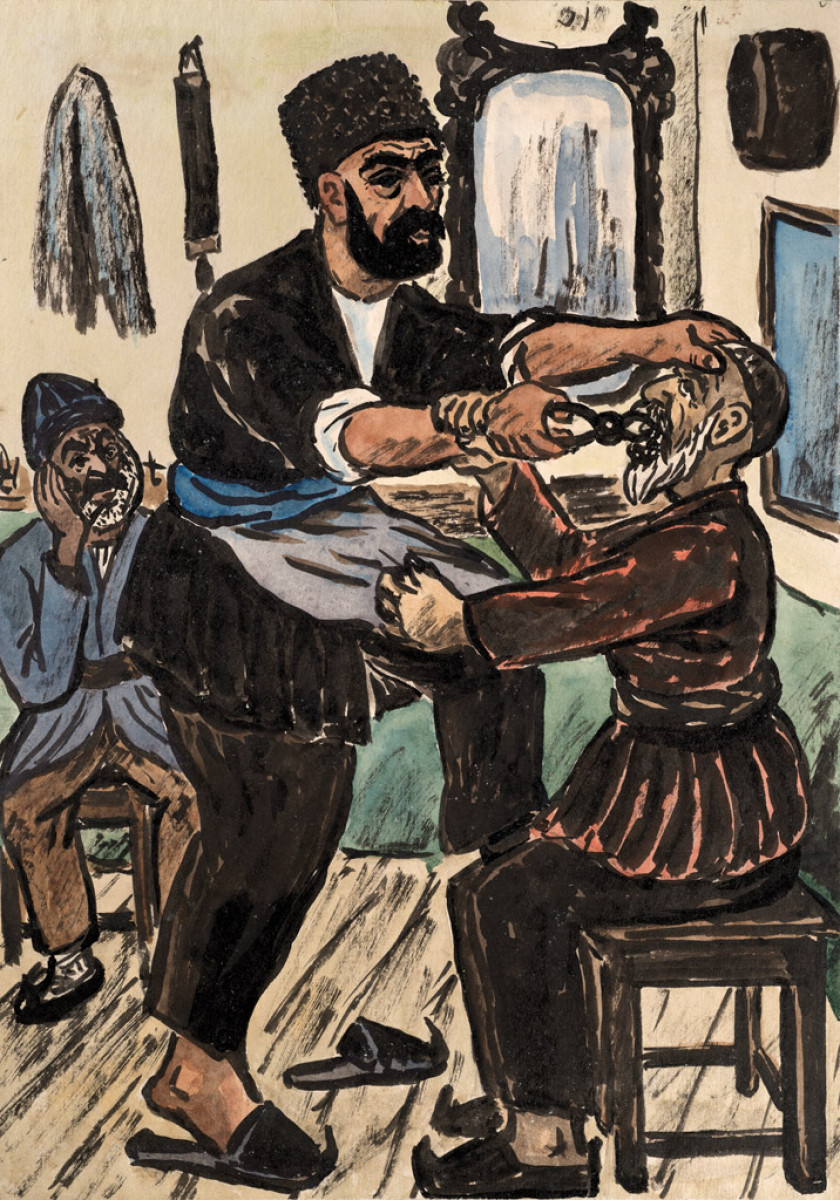
Alakbar Rzaguliyev was born in Baku in 1903. A comprehensive view of his artistic career reveals that the defining feature of his work lies less in the diversity of his subjects than in the way observed life is transformed into graphic form. A city street, a human figure, a labour process, a domestic scene or a particular profession appear in his works not simply as separate subjects, but as specific situations selected for representation.
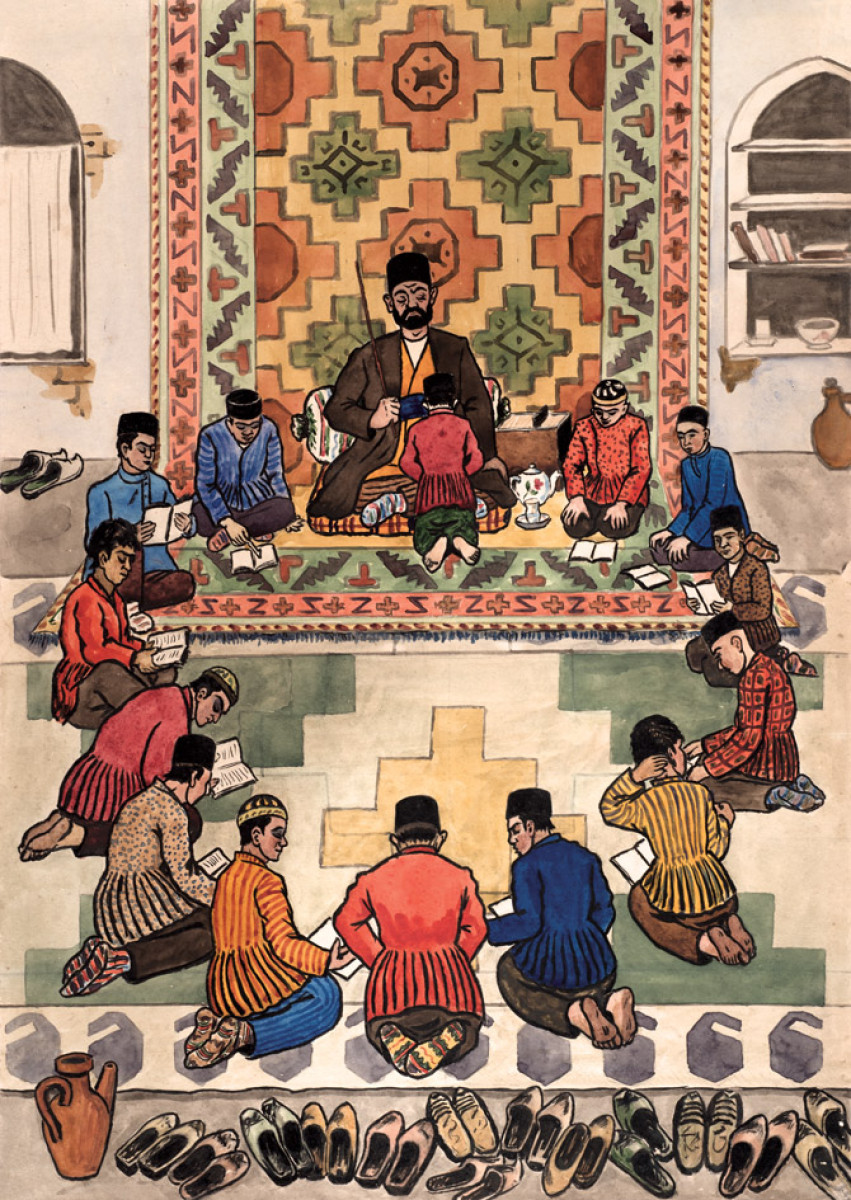
Having received his early artistic training in Baku, Rzaguliyev began studying at the Higher Art and Technical Workshops (VKHUTEMAS) in Moscow in 1925, where he continued his professional training in drawing and painting. During his early period, he also worked in painting. Works such as “Azerbaijani Woman” (1926), “Wrestlers” (1926) and “Mollakhana” (1927) reflect an earlier direction that preceded his later graphic practice.
In the following period, graphic art became the principal field of his artistic activity. Form became more concentrated, while representation was reduced to its essential visual features.
The Reduction of Form
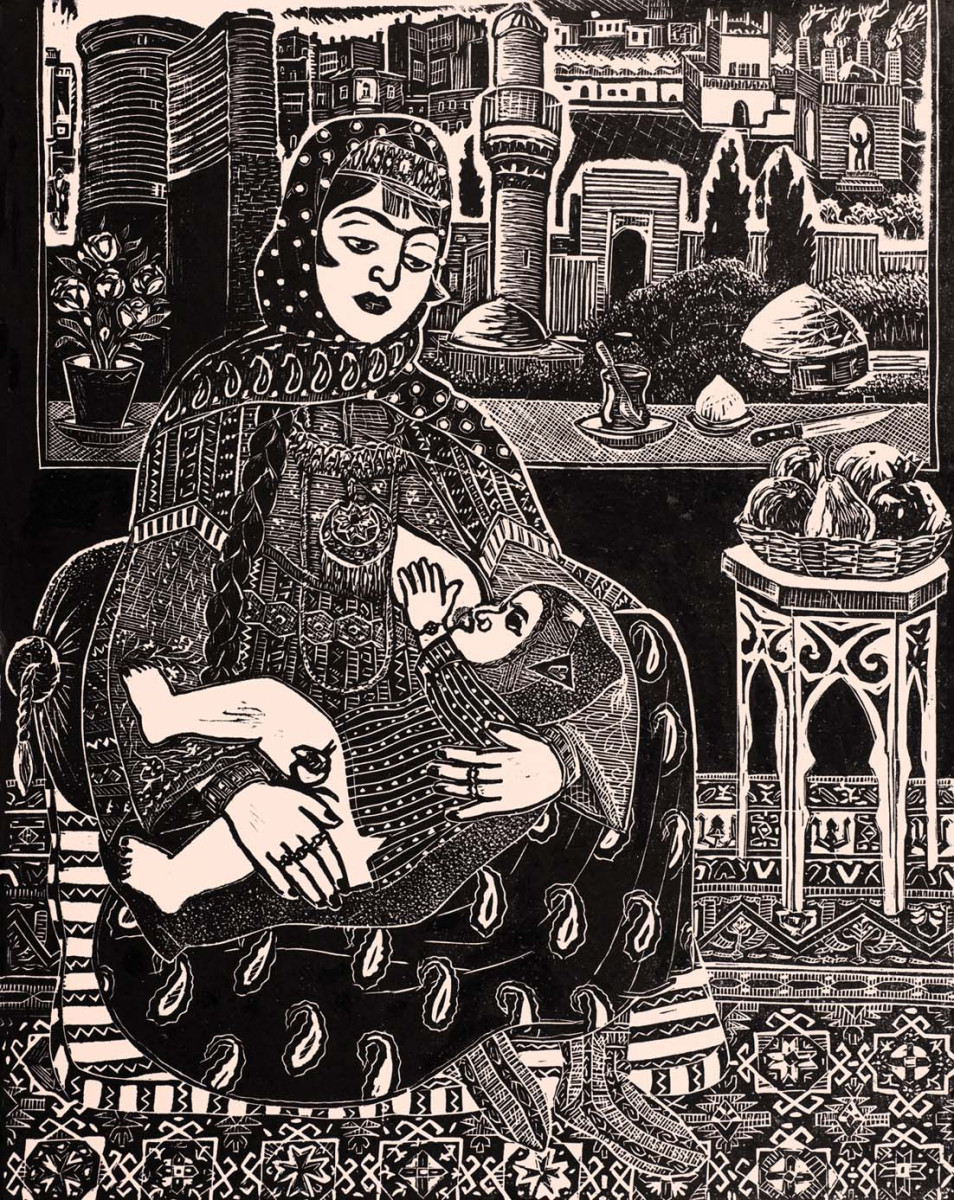
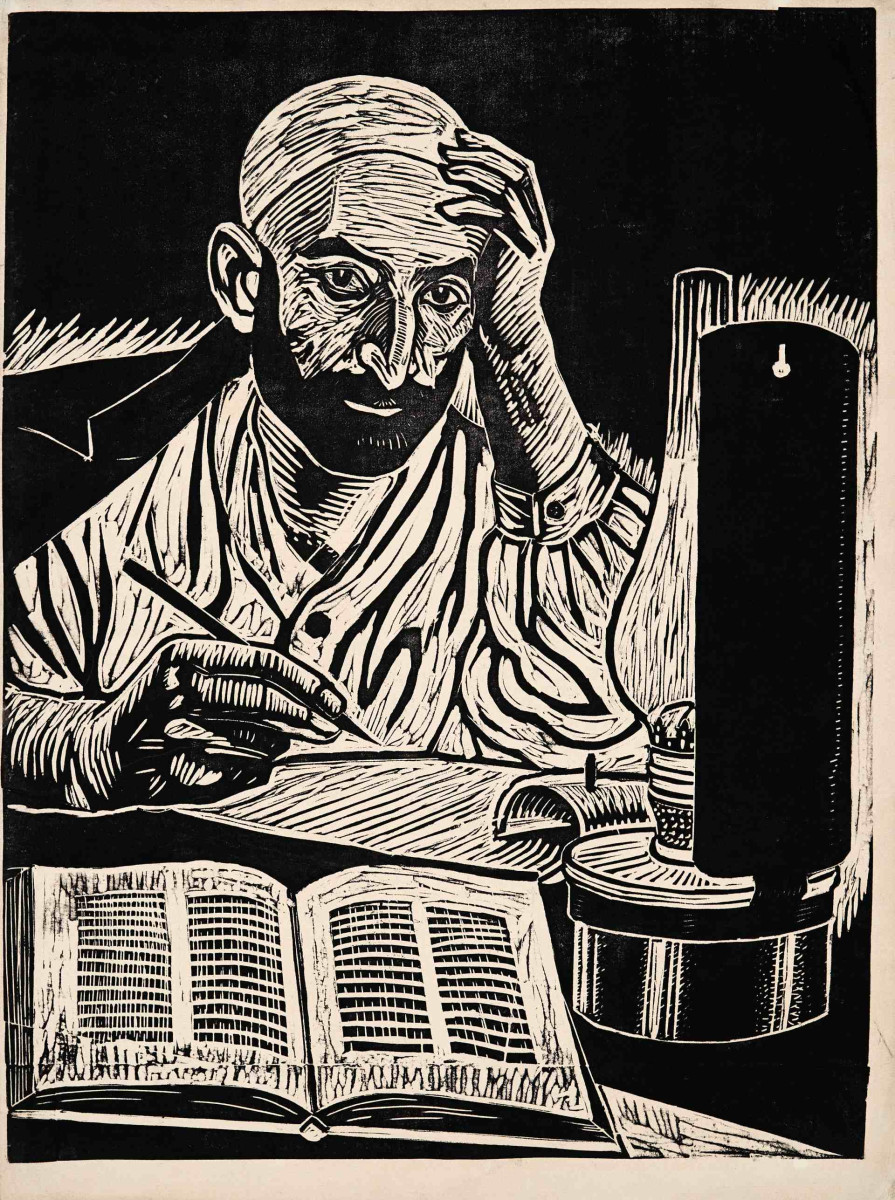
In Rzaguliyev’s linocuts, visual impact arises not from an abundance of detail, but from the precise relationship between selected elements. The position of a figure, the contour of clothing, an architectural detail and the placement of empty space within the composition determine the character of the scene.
In this sense, the line is more than an outline. It separates primary elements from secondary ones and directs the viewer’s gaze. The nature of linocut itself requires a process of selection: which form should remain, and which detail should be omitted?
The connection between Rzaguliyev’s graphic art and the traditions of ancient Azerbaijani miniature painting has been noted in art-historical research. This relationship is evident not merely in superficial stylistic similarities, but also in the way complex scenes are constructed through selected figures and clear compositional relationships.
Baku: More Than a Panorama, a Situation
Baku occupies a distinctive place in Rzaguliyev’s work. Yet his approach to the city differs from the conventional panoramic view.
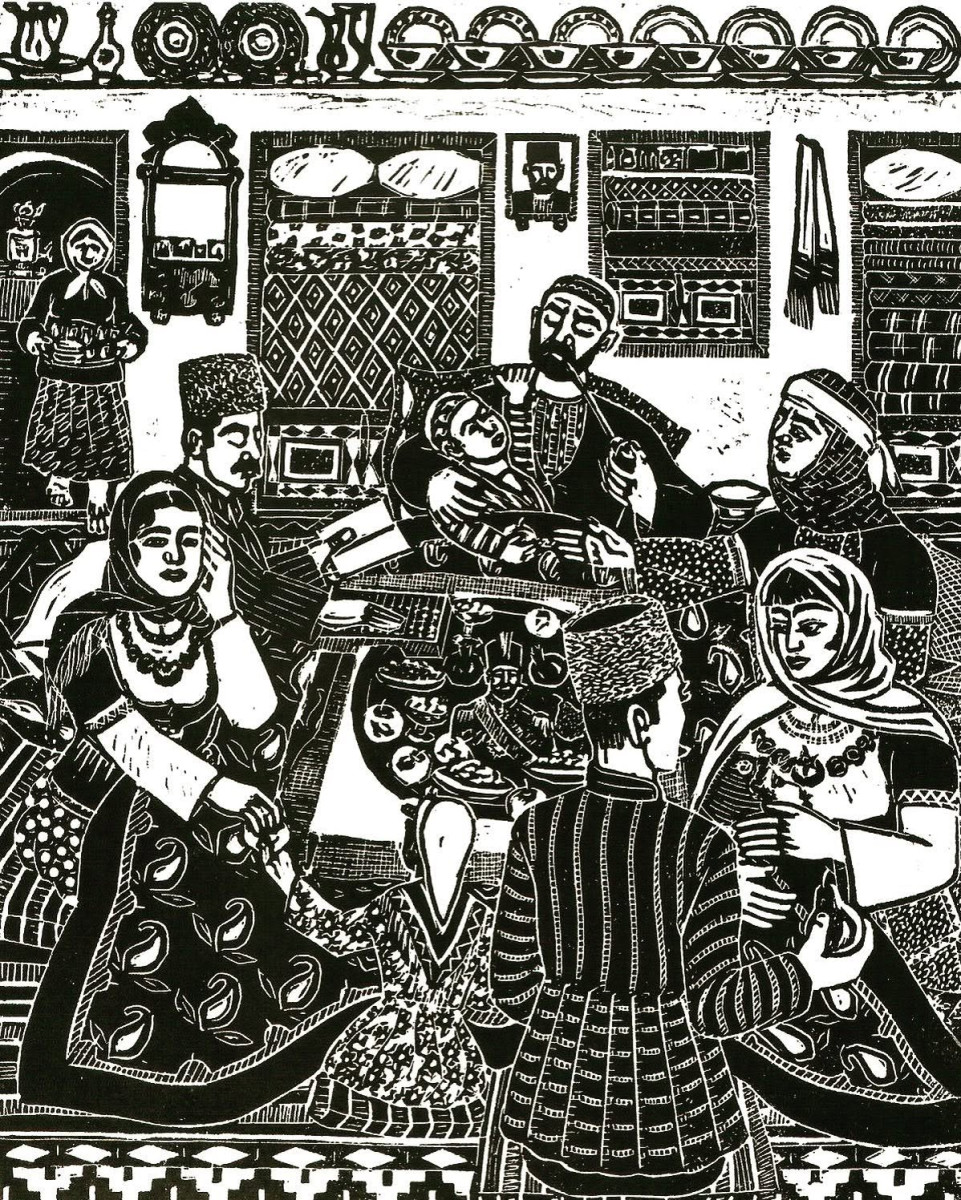
In the “Old Baku” series, attention is directed less toward a complete view of the city than toward a particular section of a street, an architectural fragment and the people inhabiting that space. The character of the city emerges not from individual views alone, but from the overall impression created by these fragments.
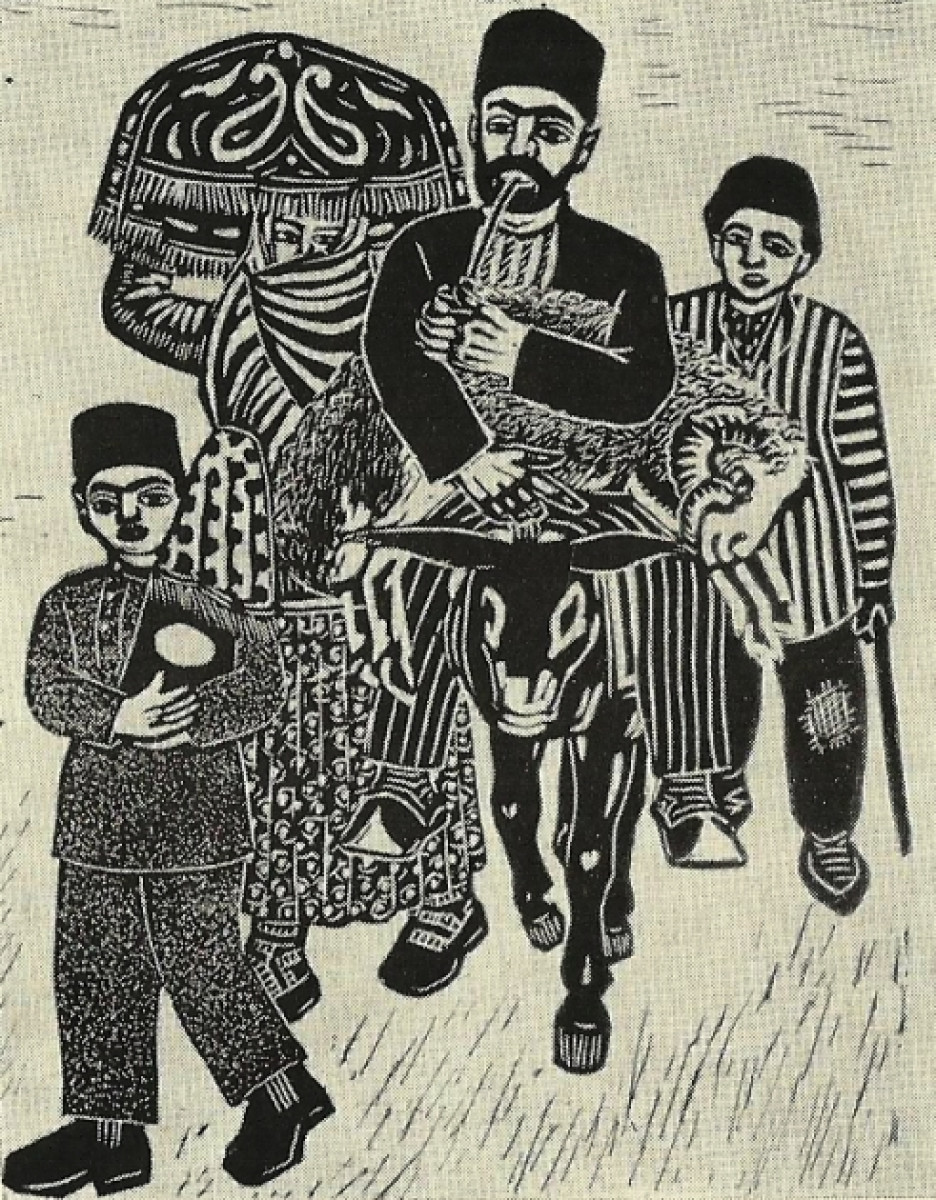
Sources indicate that the “Old Baku” series spans the years 1958–1972. “To the Spring” (1962) and “With a Gift for the Bride” (1965), both held in the collection of the Azerbaijan National Museum of Art, are specific examples from the series. Both works are linocuts on paper.
Here, architecture is not the principal subject in itself. It is the setting in which human activity takes place. The character of the city is revealed through the figures, movements and everyday interactions taking place in its streets.
The Human Figure and Labour
In Rzaguliyev’s graphics, the human being is often presented not as a monumental hero, but within the context of a particular activity. This is especially evident in works devoted to labour, including the series “Azerbaijani Fishermen”, “Azerbaijani Tobacco Growers”, “Azerbaijani Cotton Growers” and “Azerbaijani Carpet Weavers”.
The artist does not merely depict a profession. Human movement, tools, the working environment and the surrounding space are brought together within a single composition. As a result, information about a profession is conveyed not through text, but through the behaviour of the figures and the structure of the image.
Thus, although a Baku street and a field of labour differ in subject, they are connected by the same graphic principle: selection, reduction and the emphasis of essential forms.
From Subject to Form
It is precisely this formal continuity that creates a connection between the different subjects in Rzaguliyev’s work. Fishing, carpet weaving, urban life and historical figures carry different meanings, yet a similar discipline can be observed in their graphic treatment.
The clarification of silhouettes, the contrast between black and white areas, the precise placement of figures within the composition and the elimination of unnecessary details bring his different series together within a coherent graphic mode of thought.
For this reason, Rzaguliyev’s artistic career cannot be adequately presented simply as a list of subjects. The subjects change, but the way of seeing that organizes them remains consistent.
Behind Black and White
In Rzaguliyev’s graphics, the relationship between black and white carries significance beyond a technical device. Their contrast determines the structure of the image and its visual rhythm.
Rather than reproducing a scene in all its details, the artist retains the essential features that make it recognizable. As a result, although his works originate in concrete observation, they acquire a more generalized visual effect.
For Rzaguliyev, linocut is not merely a technique; it becomes a means of transforming observation into a concise and expressive graphic form.
The Expansion of a Creative Line
Rzaguliyev’s work is not limited to “Old Baku”. Works such as “M. A. Sabir” (1963), “Baku Residents in Berlin” (1968), “V. I. Lenin and the Leaders of Azerbaijan” (1970), “Tea Growers” (1972) and “Azerbaijani Madonna” (1973) demonstrate the breadth of his subject matter.
Historical figures, labourers, city residents and different social environments carry distinct meanings in these works. Yet the principle of transforming observation into a concrete graphic structure remains consistent throughout them.
The Line of Time
“The Line of Time” allows this body of work to be understood not simply as a depiction of the past, but as a continuous graphic observation in which different fragments of life are connected to one another.
The “line” is both Rzaguliyev’s principal means of expression and the principle that connects his work across different subjects. “Time” is revealed not only through historical events, but also through details of how people worked, dressed, lived and organized their everyday lives.
In this sense, Rzaguliyev’s graphics do more than document the past. They transform the people and spaces of a particular period into visual forms that remain memorable.
Rzaguliyev’s Graphic Legacy
The significance of Alakbar Rzaguliyev in Azerbaijani graphic art can be seen less in the breadth of his subject matter than in his ability to transform everyday life into a selected and concise graphic form.
The Baku street, the labour process, the human figure and the detail of domestic life do not remain incidental observations in his works. The artist selects them, organizes them within the composition and removes what is unnecessary, making what is essential visible.
For this reason, Rzaguliyev’s works are not merely depictions of a particular period. They are also examples of how observation can be transformed into art.
If Rzaguliyev’s artistic trajectory were to be expressed in a single sentence, it might be stated as follows: to find an enduring graphic language within a changing life.
In 1964, he was awarded the honorary title of Honoured Artist of the Azerbaijan SSR. The artist died in Baku in 1974.
Art Space Gallery MEDIA